

If you’ve ever bought a beautiful plant from a nursery in Lahore, followed the “Zone 9” instructions on a seed packet imported from the US, and watched it die within a month — you’re not alone, and you’re not doing anything wrong. You’re just using the wrong map.
I’ve been asked this question more times than I can count in five years of consulting on home gardens, rooftop setups, and small farms across Punjab and beyond: “Which USDA zone is Pakistan in?” The honest answer is — Pakistan doesn’t have an official USDA zone, and even if we borrow the nearest equivalent, it doesn’t tell you the full story. USDA zones were built for American winters. Our biggest enemy isn’t frost. It’s heat, humidity, and dust-laden summer wind that can cook a plant alive in three days flat.
So let’s build a version of “zones” that actually makes sense for a gardener standing in Faisalabad, Multan, Abbottabad, or Karachi — not one borrowed wholesale from Minnesota. 

Why USDA Zones Don’t Translate Directly to Pakistan
USDA Plant Hardiness Zones are based on one number: the average annual minimum winter temperature. That’s useful in the US and Europe because winter cold is what kills plants there.
In Pakistan, our climate has two extremes that matter far more:
- Summer heat zones – how many days per year cross 30°C+ (in most of Punjab, Sindh, and southern KP, this is 200+ days)
- Humidity swings – the monsoon months (July–September) create fungal and rot problems that no US hardiness map accounts for
This is why a plant labeled “hardy to Zone 9–11” can survive our winter just fine and still die in June — not from cold, but from heat stress, moisture loss, and root rot triggered by monsoon humidity right after. Local nurseries rarely explain this, which is exactly why so many home gardeners here give up after their second or third failed season.
Pakistan’s Real Climatic-Gardening Zones
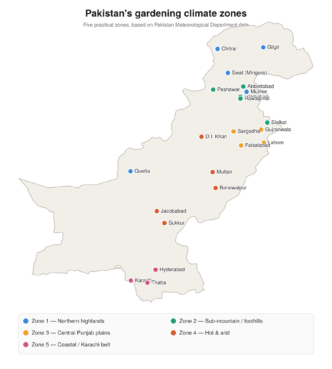
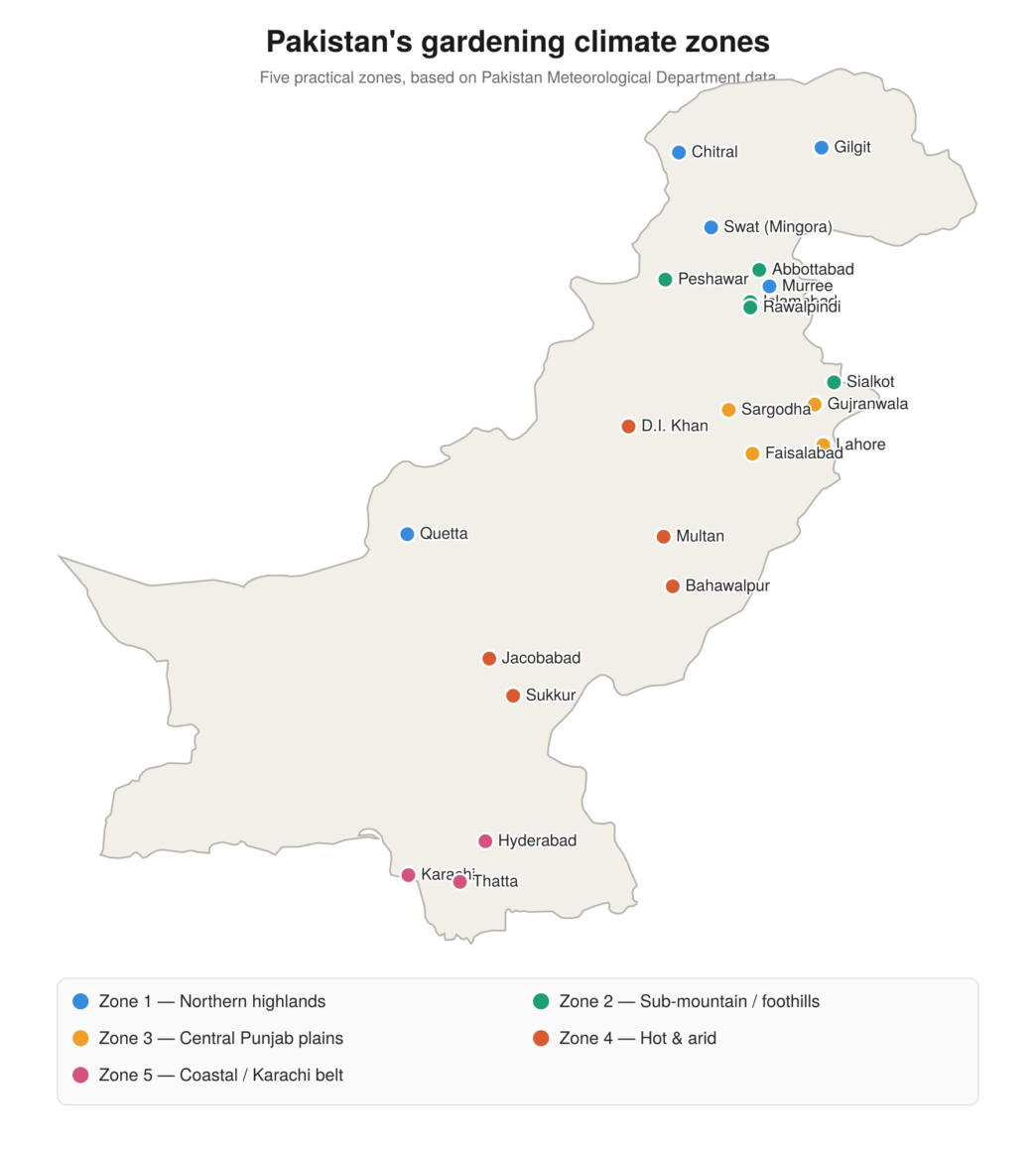
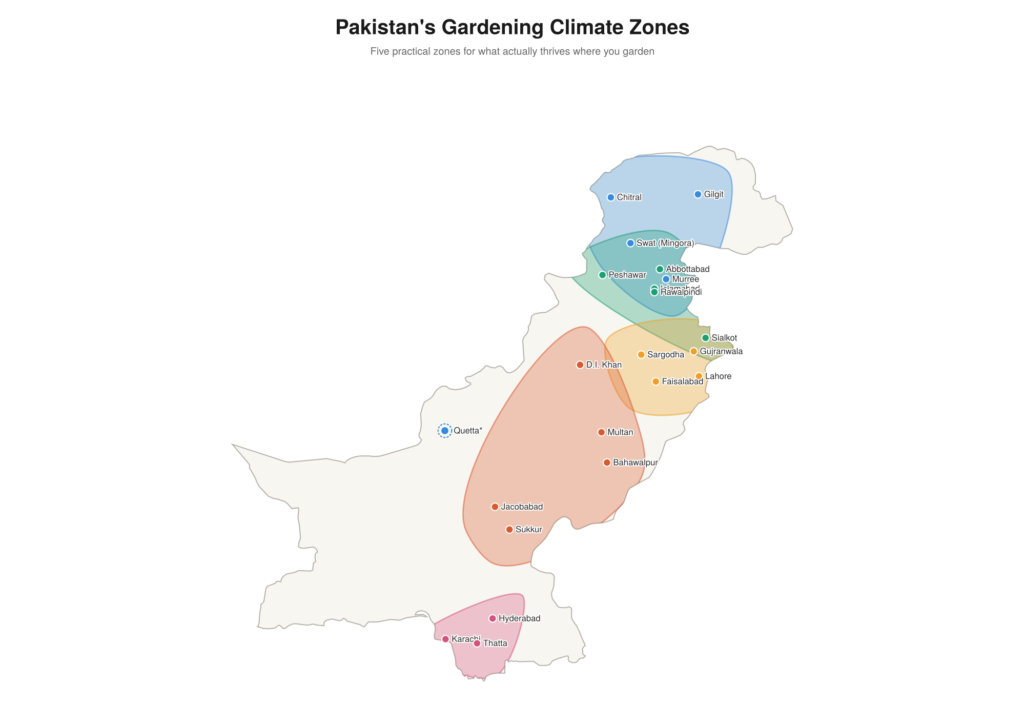
Based on Pakistan Meteorological Department data and years of field observation, Pakistan’s growing conditions break down into five practical zones — not the 13 zones of the USDA map, but five zones that actually matter for what you plant and when.
| Zone | Region / Key Cities | Nearest USDA Equivalent | Winter Character | Summer Character |
| Zone 1 – Northern Highlands | Gilgit-Baltistan, Chitral, Murree, Swat, Kaghan | 6a–8a | Hard frost, snow | Mild, short summer |
| Zone 2 – Sub-Mountain / Foothills | Islamabad, Rawalpindi, Abbottabad, Peshawar, Sialkot | 9a–9b | Light frost, cold nights | Hot but bearable, high monsoon humidity |
| Zone 3 – Central Punjab Plains | Lahore, Faisalabad, Gujranwala, Sargodha | 9b–10a | Mild, occasional frost | Extreme heat + high humidity (worst combo in the country) |
| Zone 4 – Hot & Arid | Multan, Bahawalpur, D.I. Khan, Sukkur, Jacobabad, Rohri | 10a–11 | Very mild | Extreme dry heat, often 45°C+ |
| Zone 5 – Coastal / Karachi Belt | Karachi, Hyderabad, Thatta, Badin, coastal Balochistan | 11–13 | Almost no winter | Hot, sea-humid, salt-air stress |
(Note: Quetta, Zhob, and highland Balochistan behave more like Zone 1/2 — cold winters, mild dry summers — despite being geographically “south.”)
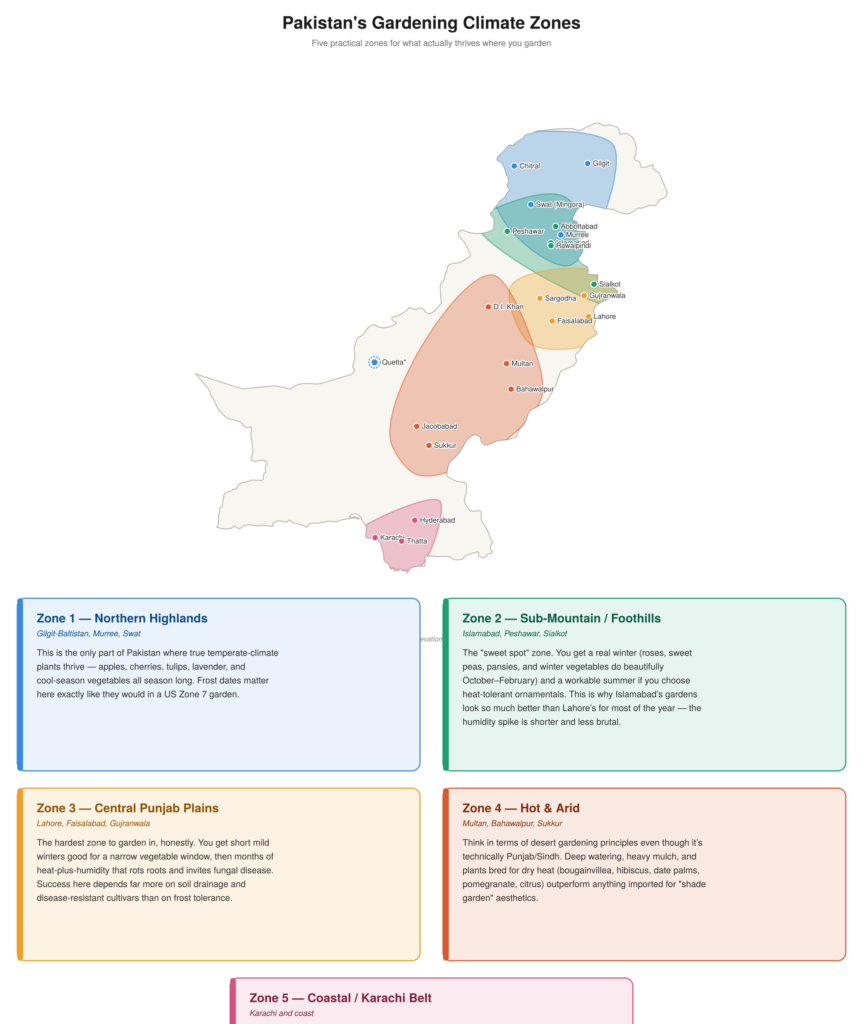
This is the zone map I actually use when I advise clients. It tells you three things a USDA number never will:
- Whether you need frost protection at all
- Whether your bigger enemy is heat or humidity
- Whether you’re working with dry heat (easier to manage with shade + mulch) or humid heat (harder — needs airflow and disease-resistant varieties)
What This Means for What You Plant
Zone 1 (Gilgit-Baltistan, Murree, Swat)
This is the only part of Pakistan where true temperate-climate plants thrive — apples, cherries, tulips, lavender, and cool-season vegetables all season long. Frost dates matter here exactly like they would in a US Zone 7 garden.
Zone 2 (Islamabad, Peshawar, Sialkot)
The “sweet spot” zone. You get a real winter (roses, sweet peas, pansies, and winter vegetables do beautifully October–February) and a workable summer if you choose heat-tolerant ornamentals. This is why Islamabad’s gardens look so much better than Lahore’s for most of the year — the humidity spike is shorter and less brutal.
Zone 3 (Lahore, Faisalabad, Gujranwala)
The hardest zone to garden in, honestly. You get short mild winters good for a narrow vegetable window, then months of heat-plus-humidity that rots roots and invites fungal disease. Success here depends far more on soil drainage and disease-resistant cultivars than on frost tolerance.
Zone 4 (Multan, Bahawalpur, Sukkur)
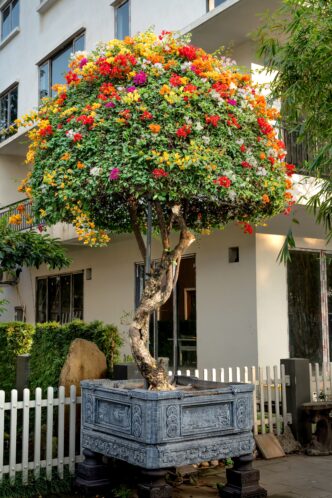
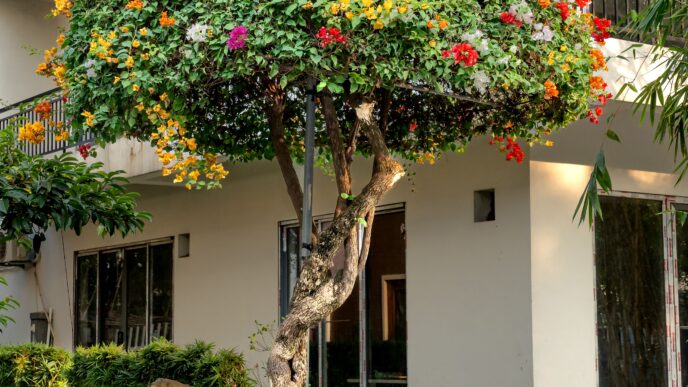
Think in terms of desert gardening principles even though it’s technically Punjab/Sindh. Deep watering, heavy mulch, and plants bred for dry heat (bougainvillea, hibiscus, date palms, pomegranate, citrus) outperform anything imported for “shade garden” aesthetics.
Zone 5 (Karachi and coast)
Salt-tolerant and wind-tolerant species are non-negotiable here. Standard nursery advice (“full sun, regular watering”) ignores the salt-air factor that kills many ornamentals within a season near the coast.
The Heat Zone Nobody Talks About
Here’s something almost no Pakistani gardening resource explains clearly: the American Horticultural Society also publishes a Heat Zone Map (1–12) based on how many days a year exceed 30°C. Most of Punjab and Sindh sits around AHS Heat Zone 10–12 — meaning 150 to 210+ days above 30°C annually.
Why does this matter to you practically? Because plant tags at nurseries only ever mention cold hardiness (“hardy to zone 9”), never heat tolerance. A plant can be perfectly cold-hardy for your region and still cook in your specific summer. When buying anything new, ask (or research) whether it tolerates sustained high heat with humidity — not just whether it survives a hot afternoon. This single check will save you more failed plants than any other single piece of advice in this article.
A Practical Planting Calendar by Zone
| Task | Zone 1 (North) | Zone 2 (Islamabad/Peshawar) | Zone 3 (Lahore/Faisalabad) | Zone 4 (Multan/Sukkur) | Zone 5 (Karachi) |
| Winter vegetables sowing | May–July | Sept–Oct | Oct–Nov | Oct–Nov | Nov–Dec |
| Summer vegetables sowing | June–July | Feb–March | Feb–March | Jan–Feb | Year-round (with shade) |
| Rose pruning | March | Jan–Feb | Jan | Jan (light only) | Not recommended without netting |
| Best flowering annual window | June–Aug | Oct–March | Oct–Feb | Nov–Feb | Nov–Feb |
Why This Matters Beyond Just “Not Killing Your Plants”
Understanding your real zone changes how you think about your garden entirely. Instead of chasing Instagram-worthy plants that were never suited to your climate, you start working with your zone — choosing bougainvillea and hibiscus in Multan instead of fighting to keep English roses alive, or embracing a genuine winter flower season in Islamabad instead of ignoring it. Gardening stops being a losing battle and starts being something that actually rewards your effort, season after season. That shift — from frustration to quiet confidence in your own soil and sky — is, honestly, the best part of this work.
FAQs: Gardening Zones in Pakistan
Q1: Does Pakistan have an official USDA hardiness zone map?
No. Pakistan has never been formally mapped by the USDA. The zone equivalents used here are derived from Pakistan Meteorological Department climate data cross-referenced with USDA minimum-temperature bands, refined through field observation.
Q2: What zone is Lahore in?
Lahore falls in Zone 3 (Central Punjab Plains), roughly equivalent to USDA 9b–10a. Its biggest challenge isn’t cold — it’s the combination of extreme summer heat and high monsoon humidity together.
Q3: What zone is Islamabad in?
Zone 2 (Sub-Mountain/Foothills), close to USDA 9a–9b. It has the most balanced climate for gardening in Pakistan — a genuine cool season and a shorter, less brutal summer than the plains.
Q4: Can I grow apples or tulips in Lahore or Karachi?
Not reliably outdoors. These need sustained winter chill hours found only in Zone 1 (Gilgit-Baltistan, Murree, Chitral, Swat). In Lahore or Karachi, they may flower once with cold storage tricks but won’t thrive long-term.
Q5: Why do my plants survive winter but die in summer?
This is the single most common issue in Pakistani gardens. Most plant labels only describe cold hardiness, not heat or humidity tolerance. Your plant likely isn’t frost-sensitive — it’s heat- or humidity-sensitive, which almost no local nursery tag will warn you about.
Q6: Is Karachi’s coastal climate good or bad for gardening?
Both. Almost no frost means year-round growing potential, but salt-laden air and wind damage many standard ornamentals. Success depends on choosing salt-tolerant species rather than fighting the coastal air.
Q7: How do I find my exact zone if my city isn’t listed?
Match your city to the nearest listed city with similar latitude, elevation, and distance from the coast. Elevation matters more than latitude alone — a city at 1,000m+ will behave like a cooler zone even at the same latitude as a plains city.
Once you know your real zone — not the one on an imported seed packet, but the one written into your own soil, sky, and season — gardening in Pakistan stops feeling like guesswork. Start there, choose plants that were always meant for your climate, and watch how much easier the whole season becomes.